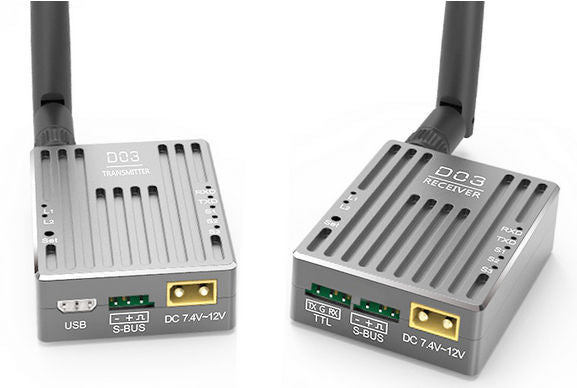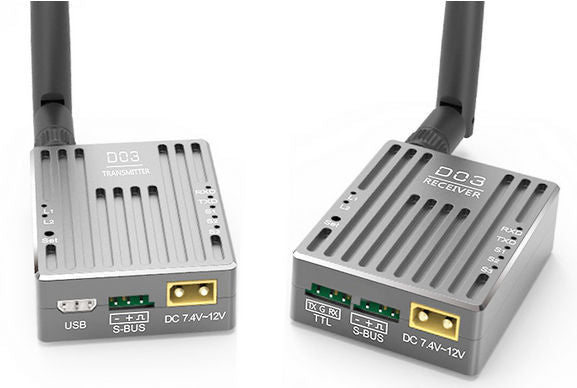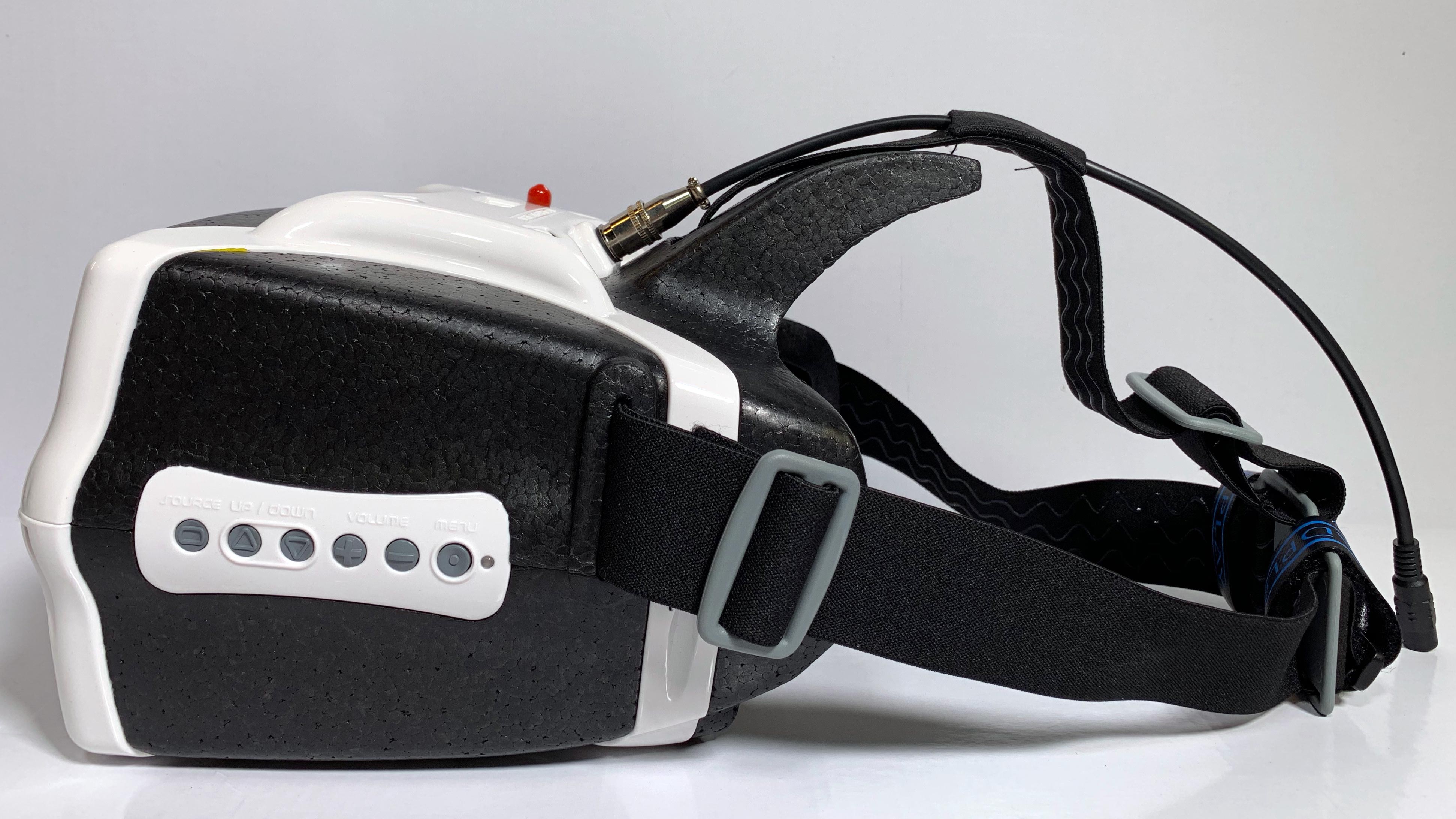
NOT SOLD SEPARATELY - ONLY IN THE SET WITH Tx.
This ultra small and lightweight transmitter has outstanding performance. The sensitive receiver, when used in conjunction with an 8dBi Patch antenna, can receive up to 1.5 km! For reference: a model airplane with a wingspan of one meter, flying at 600 meters looks like a dot from the ground. The transmitter has 4 bare wires which can easily be connected to your camera and power supply.
System features:
Your purchase comes with:
Audio/Video Transmitter:
5.5V 39mA +12.0dBm 2.47024 GHz 5.0V 34mA +10.8dBm 2.47024 GHz 4.5V 30mA +9.6dBm 2.47028 GHz 4.0V 26mA +8.2dBm 2.47024 GHz 3.8V the VCO did not lock, plenty of supply margin, and frequency nice stable
The transmitter was soldered to SMA connector, and mounted directly to spectrum analyzer to avoid loss
Channel selection: How to set channels with solder joints, X mean solder joint to ground
A B C D X X X X 2.410 CH1 X X X 2.411 X X X 2.408 X X 2.414 X X X 2.450 CH3 X X 2.453 X X 2.448 X 2.450 X X X 2.430 CH2 X X 2.433 X X 2.428 X 2.432 X X 2.470 CH4 X 2.473 X 2.468 n o n e 2.468 (factory default)
Audio/Video Receiver:
CH1 2414 MHz
CH2 2432 MHz
CH3 2450 MHz
CH4 2468 MHz
Sensitivity: -97dB (-91dBm with TV signals)
Accessories:
By: Thomas Scherrer Foreword: Now wireless video can be put on tiny tiny planes, with this super tiny transmitter The compleete set I got from rangevideo came with antenna also.
inside the RX
not much to see, it is all integrated into the metal shield case.
this one is frequency stable, no tuning knob !, the 4 channels are selected with a pushbutton The receiver is supplied with 10-14V DC center pin positive, using a standard 2.1mm DC jack, nice There is NO reverse polarity protection so bad stuff will happen if you are unlucky with this. Video and Audio connectors are phono so no need for them adapter cables that always get lost. The internal circuit is running on 5V from one linear regulator with after my taste a way to little heat sink with case open I measured 61 C after 10 minutes, and with case closed this will be much more, I think either give this receiver 9-10V or mount the regulator and hot power resistor so they can transfer their heat to the case
Here the red buttom OLD type, at -96dBm and -98dBm and -100dBm Sensitivity: -97dB the new type with yellow button (-91dBm with TV signals) Sensitivity: -96dB the old type with red button (-90dBm with TV signals) Supply Volt and Current : 12V 214mA
Receiver center frequency: measured with Agilent E4438C 3MHz dev 100kHz sine old-type new-type CH1 2.412 2.412 CH2 2.430 2.438 CH3 2.447 2.457 CH4 2.465 2.475
A B C D X X X X 2.410 CH1 X X X 2.411 X X X 2.408 X X 2.414 X X X 2.450 CH3 X X 2.453 X X 2.448 X 2.450 X X X 2.430 CH2 X X 2.433 X X 2.428 X 2.432 X X 2.470 CH4 (factory default) X 2.473 X 2.468 n o n e 2.468
Spurious Harmonics :
2.470 +10dBm fundamental wanted frequency 4.940 -39dBm 2nd 7.416 -47dBm 3rd 9.880 -27dBm 4th quite strong this one 12.350 -42dBm 5th 14.821 -47dBm 6th 17.290 nothing to see, all the way up from here, still nothing.
Here at 5.0V over 10mW of power, nice.
The delta from video to audio is 6.5Mhz and -19dB
the transmitter was soldered to SMA connector, and mounted directly to spectrum analyzer to awoid loss
Range test: later Video picture looks just as good as a wire connection when I tested indoor The video source drives my different monitors and googles well.
This page is still under construction.. wait a few days for more.
With the popular Lawmate and Airwave transmitter modules that are sold by various vendors it is relatively easy to get a FPV camera setup up and running. Unfortunately these regularly use a cased KX-131 camera and a 500mW 2.4GHz transmitter, a combination which isn't exactly small, lightweight or power efficient. For smaller planes, or those trying to save as much weight as possible, this poses a bit of challenge. However in my quest to find exactly such a solution I came across a miniature 10mW 2.4GHz Tx sold by Rangevideo (http://www.rangevideo.com). This Tx has ample power to allow for FPV flying up to about 1km away. Below you'll find a detailed description how you can use that miniature Tx to create a miniature, yet high resolution, FPV camera. In order to save as much weight as possible it makes sense to use an uncased KX-131, which not only shaves about 10-grams off of the weight of the cased version, but also can be powered off of 5V directly, a voltage which we have available in any RC plane already. The Tx itself is also running off of 5V hence we tackled our power requirement issues in one fell swoop. Below you'll find the uncased KX-131 camera and 10mW Tx pictured. I already attached a lead with a JST plug that plugs directly into a spare channel on your receiver.
Uncased KX-131 and miniature 10mW 2.4GHz Tx I've opted to glue the miniature Tx to the back of the KX-131 camera directly using 5-min epoxy, but obviously it needs to be shrink wrapped prior to doing so, else we might get shorts or worse. I use the same type of shrink wrap that's used with battery packs, this is very thin, light and durable. An added benefit is that it mechnically strengthens the wires coming from the Tx and provides a surface for the glue to adhere to. Also, if you ever need to remove the miniature Tx you only have to cut the shrink wrap to gain access to it. I opted to remove the connector header on the KX-131 and solder the wires onto the PCB directly. Miniature 10mW 2.4GHz Tx shrink wrapped and connected to KX-131 KX-131 camera and miniature 10mW 2.4GHz Tx glued together Now we need to make a stable base for the KX-131 camera and the miniature Tx to be attached to. I often use L-shaped ABS plastic strip for these kind of things, as it is light, durable and can easily be drilled, milled, sanded or cut to size. I cut a length of black ABS strip to the right size, drilled an 8-mm hole in the bottom and milled a 3-mm slit in the back for the power lead to pass through. The 8-mm hole in the bottom will hold a 8-mm neodymium magnet which mates with another that's glued to the plane's fuselage. All pieces are subsequently (in steps, not all at once) glued in place using 5-min epoxy. The pictures below illustrate how it all goes together. L-shaped ABS strip to attach camera and Tx to, front view L-shaped ABS strip to attach camera and Tx to, back view When the 5-min epoxy has cured you're left with a sturdy, yet miniature, FPV camera setup that'll take some abuse and come back for more. All that's needed now is a shrink wrap around it to protect it from the elements, ie. rain, dust, sand, bird poo and of course the inevitable landing that went awry. When that's done, all that's needed is to connect it to a free channel on the remote control receiver, turn on the video receiver and dail in the right channel and you're good to go, provided you attached the miniature FPV camera to your plane properly first of course. The finished miniature FPV camera, looking spiffy Obviously this little how-to wouldn't be complete without some comments about weight, power consumption and all that other information that matters to us FPV enthusiasts. The miniature FPV camera tips the scale at just 28-grams, which should make it something of a record I guess, just don't sneeze at the field when you're holding it, it might get lost in the grass. Power consumption is a mere 190mA at 5V, which translates to almost 1W. However this does not pose a problem for the majority of ESCs with BEC, those are rated at 2A mostly, hence 190mA will not cause for an alarming raise in temperature. By: Sander.Sassen, Hardwareanalysis.com